Who makes CFMOTO engines? It is a simple question, but the answer requires considerably more history than the one-line response often found on motorcycle forums and social media. CFMOTO is not simply a motorcycle badge attached to an engine produced by another company. The company has spent decades developing its own manufacturing infrastructure, engine technology, research capability and vehicle platforms.
CFMOTO began in China in 1989 as a motorcycle-parts workshop founded by a father and son. Eight years later, in 1997, the company reached one of its earliest major engineering milestones: the successful development of its first liquid-cooled engine. In 1998, CFMOTO introduced its first complete two-wheeled vehicle. The company later expanded into ATVs, UTVs, larger motorcycles, electric mobility and increasingly sophisticated high-performance machines.
That history is important because many people still ask: Does CFMOTO make its own engines? Others want to know where CFMOTO engines are made, whether CFMOTO engines are reliable, or whether KTM actually manufactures the engines used in CFMOTO motorcycles.
The KTM question is legitimate. CFMOTO and KTM have a substantial industrial relationship that includes distribution, CKD manufacturing and a joint venture. But describing every CFMOTO engine as a KTM engine ignores CFMOTO's own development history and its current powertrain capabilities.
This article therefore takes a broader approach. Instead of repeating a simple “CFMOTO versus KTM” argument, it follows the engine story from CFMOTO's origins through its first liquid-cooled engine, the development of single-cylinder, parallel-twin, V-twin and three-cylinder platforms, its off-road powertrains, its racing involvement and finally its 997cc V4.
The final chapter is particularly interesting. In 2026, CFMOTO reported that its V4 SR-RR reached 315.82 km/h during a closed-course speed test. CFMOTO says the motorcycle used a 997cc 90-degree V4 engine developed entirely in-house, with claimed output of 157 kW, or more than 210 horsepower, and a maximum engine speed of 15,000 rpm.
Who Makes CFMOTO Engines?
CFMOTO makes and develops its own engines. More specifically, the company has developed extensive engine engineering and manufacturing capabilities through Zhejiang Chunfeng Power and its associated powertrain operations in China.
CFMOTO's official corporate history identifies 1989 as the beginning of the company and records September 1997 as the date when it successfully developed its first liquid-cooled engine. That means engine development was already an important part of CFMOTO's story before its later relationship with KTM.
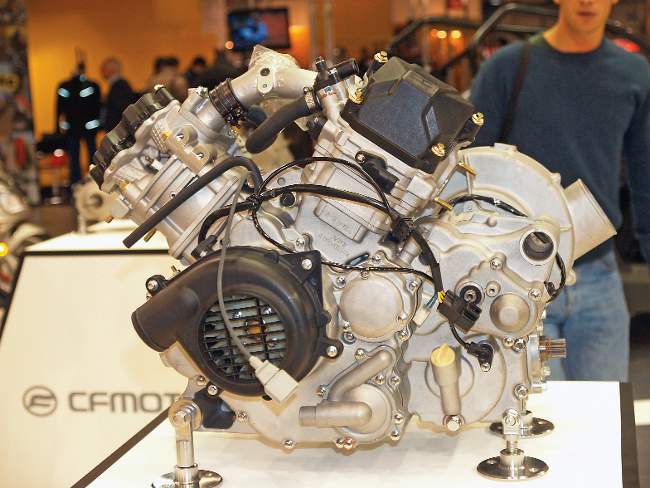
Today, the company's engine portfolio covers numerous architectures and displacement classes. Its powertrain development includes single-cylinder, parallel-twin, V-twin and three-cylinder engines, as well as the much more ambitious 997cc V4 platform.
Therefore, if someone asks, “Who manufactures CFMOTO engines?”, the answer should not simply be “KTM.” CFMOTO has its own engineering organization, manufacturing facilities and engine-development history.
CFMOTO has its own engine-development and manufacturing capabilities while also maintaining an important technical and industrial relationship with KTM. Both statements can be true simultaneously.
Does CFMOTO Make Its Own Engines?
Yes. Does CFMOTO make its own engines? is one of the most important questions in this entire subject, because the answer helps explain why the company's current motorcycles look very different from its earliest products.
CFMOTO's official history documents the development of its first liquid-cooled engine in 1997. The company subsequently developed motorcycles, ATVs and other powersports vehicles around its growing powertrain capability.
CFMOTO has also described its ability to independently develop and produce large-displacement liquid-cooled engines. Its engine development history includes multiple cylinder configurations rather than one universal engine architecture.
That distinction is particularly important when someone encounters online claims that “CFMOTO does not make engines.” Such claims usually confuse three different things: a company using technology developed through cooperation, a company manufacturing a partner's engine, and a company independently developing its own engine families.
CFMOTO has participated in all three types of industrial activity across different periods and products, but that does not mean the company's entire engine portfolio comes from one outside manufacturer.
Modern CFMOTO documentation provides numerous examples of self-developed engines. The company describes the 675 platform as an in-house three-cylinder engine, while its current 150AURA uses a self-developed 149.5cc liquid-cooled four-valve single-cylinder engine.
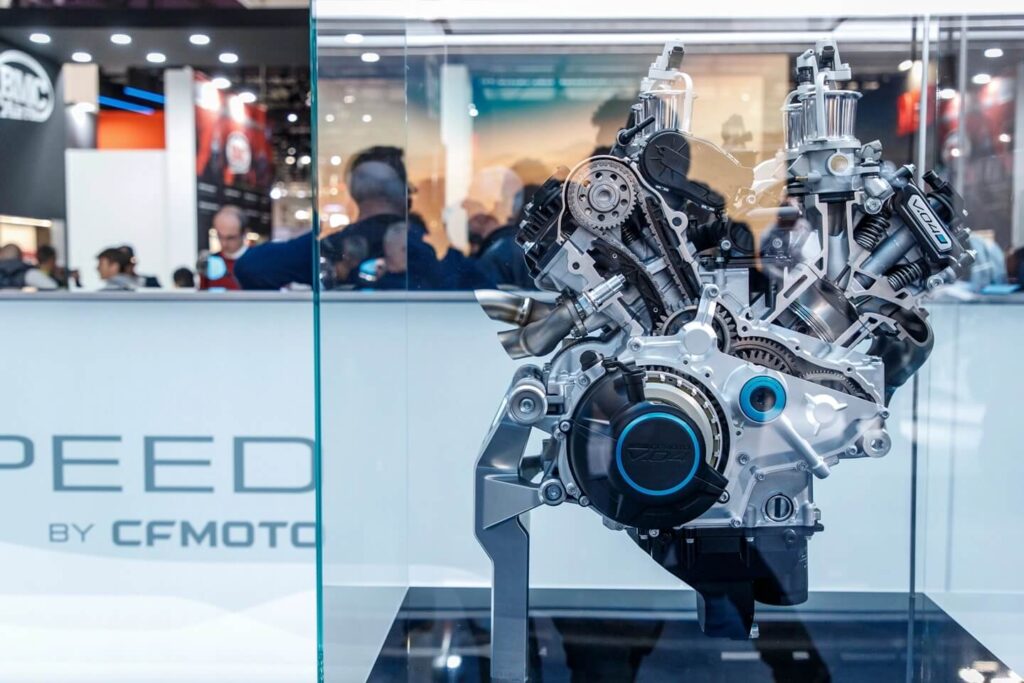
At the highest end of the range, CFMOTO describes the 997cc V4 used in the V4 SR-RR as an engine developed entirely in-house.
The evidence therefore supports a clear answer: CFMOTO does make its own engines.
Where Are CFMOTO Engines Made?
Where are CFMOTO engines made? The central answer is China, particularly CFMOTO's manufacturing infrastructure in and around Hangzhou, Zhejiang Province.
Hangzhou is important to the CFMOTO story because it is not simply an administrative headquarters. The company has major manufacturing and engineering operations in the region, including facilities producing engines, motorcycles and off-road vehicles.
CFMOTO's international manufacturing network has also expanded. The company's corporate history identifies manufacturing operations in China and later international facilities including Thailand and Mexico.
This means the phrase “CFMOTO engines are made in China” is broadly accurate, but it does not tell the entire industrial story. CFMOTO is increasingly an international manufacturer with engineering, production, distribution and sales infrastructure spanning multiple regions.
Why Does the Manufacturing Location Matter?
Manufacturing location alone does not determine engine quality. Japan, Germany, Italy, the United States, China and other manufacturing countries all produce both excellent and poor mechanical products. What matters is the engineering standard, manufacturing process, quality control, materials, testing and after-sales support behind the product.
CFMOTO's development from a small motorcycle-parts workshop into a large powersports manufacturer is therefore more meaningful than simply asking which country appears on the engine.
The Origins of CFMOTO: Before the Modern Engine
To understand who manufactures CFMOTO engines, it is useful to go back to February 1989.
According to CFMOTO's official history, a father and son established a motorcycle-parts workshop in Wenzhou. This small operation became the foundation of the company now known internationally as CFMOTO.
That origin matters because CFMOTO's later engine capability was not created in a single product launch. It developed through years of manufacturing experience.
Motorcycle manufacturing naturally exposes a company to the complexity of engines, transmissions, cooling systems, fuel systems, chassis integration and quality control. The transition from components to complete vehicles therefore created a path toward more sophisticated internal engineering.
CFMOTO's subsequent growth demonstrates that its strategy was not limited to importing complete powertrains and assembling them into finished vehicles.
1997: CFMOTO's First Liquid-Cooled Engine
One of the most important dates in the history of the CFMOTO engine is September 1997.
CFMOTO's official corporate history identifies this as the point when the company successfully developed its first liquid-cooled engine.
Liquid cooling was a meaningful technical milestone because it requires a coordinated thermal-management system. Instead of relying primarily on airflow across the cylinder and cylinder head, a liquid-cooled engine circulates coolant through passages and transfers heat to a radiator.
This brings additional engineering requirements involving coolant circulation, radiator capacity, water-pump performance, thermal expansion, cylinder-head temperature management and lubrication.
For CFMOTO, the 1997 milestone therefore represented more than another engine on a production line. It demonstrated that the company was developing the ability to engineer and manufacture more sophisticated powertrains.
That foundation would later support the company's transition into larger motorcycles and off-road vehicles.
From Engines to Motorcycles, ATVs and UTVs
CFMOTO introduced its first complete two-wheeled vehicle in 1998. The company's first ATV followed in 2005.
This was a critical expansion because an engine designed for a motorcycle does not necessarily serve the same purpose in an ATV or UTV.
Motorcycle engines commonly prioritize weight, acceleration, packaging and high-rpm performance. Off-road utility vehicles can place greater emphasis on torque, cooling, low-speed control, continuous load and drivetrain integration.
CFMOTO therefore had to develop powertrains for different operating environments.
The company's history records the refinement of a 500cc motor in 2004, followed by the first CFMOTO off-road vehicle in 2005. CFMOTO later passed the one-million-unit cumulative ATV production milestone in October 2024.
That off-road history is important when evaluating the question are CFMOTO engines reliable? An engine family used across recreational and utility applications faces a different collection of demands from a small commuter motorcycle.
CFMOTO Powertrain Development: From Manufacturing to Engineering
An engine manufacturer needs more than an assembly line.
Modern engine development involves combustion analysis, cooling, lubrication, electronic fuel injection, materials, vibration control, emissions, calibration, durability testing and manufacturing precision.
CFMOTO's corporate materials describe an engineering strategy that increasingly emphasizes independent research and development. The company has developed its own engine architectures across multiple displacement classes.
This evolution can be seen clearly in the company's current product range. A modern CFMOTO engine may feature DOHC valve trains, liquid cooling, electronic fuel injection, multiple cylinders, balance shafts, modern engine-management systems and sophisticated emissions control.
These technologies are not unique to CFMOTO. They are standard requirements for competing in the modern global motorcycle industry. What is significant is that CFMOTO has developed the capability to apply them across a broad product portfolio.
Who Manufactures CFMOTO Engines? The Role of Hanjing Power
One of the clearest answers to the question who manufactures CFMOTO engines? comes from the company's dedicated powertrain operations.
CFMOTO's Hanjing Power operation focuses on engine research, development, manufacturing and marketing.
Its published engine portfolio demonstrates how broad CFMOTO's powertrain strategy has become. The company presents engine platforms across multiple displacement classes and vehicle categories.
Single-Cylinder Platforms
CFMOTO develops liquid-cooled and other single-cylinder powertrains for scooters, motorcycles and off-road applications.
Parallel Twins
Twin-cylinder engines have become central to CFMOTO's adventure, touring, cruiser and naked-bike portfolio.
Three-Cylinder Engines
The 675cc triple demonstrates CFMOTO's move into increasingly performance-oriented engine architectures.
V-Twin Platforms
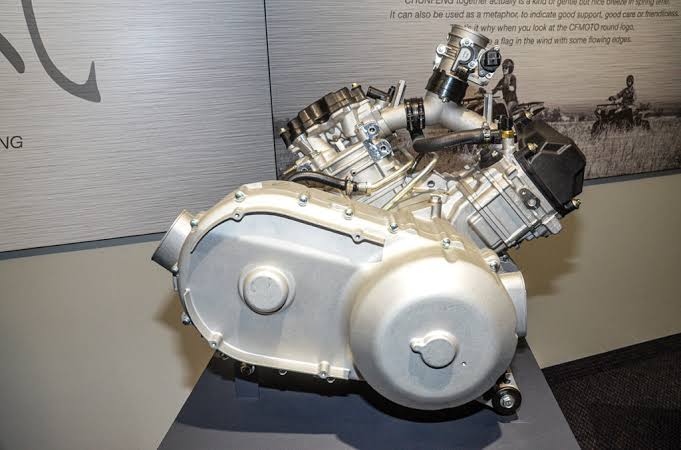
V-twin powertrains support larger motorcycles and off-road applications where torque and character are important.
1000cc-Class Engines
Large-displacement parallel-twin and V-twin platforms compete in premium adventure, touring and performance categories.
997cc V4
The V4 SR-RR represents CFMOTO's most dramatic move into liter-class superbike engine technology.
Modern CFMOTO Engine Platforms
The modern CFMOTO engine portfolio is not one standardized motor. It is a collection of platforms developed for different applications.
The 450cc Parallel Twin
CFMOTO's 450cc engine family uses a liquid-cooled parallel-twin architecture with DOHC and electronic fuel injection in relevant applications. This engine class is important because middleweight motorcycles are among the most competitive segments in the global market.
Buyers in this category often want a combination of usable torque, manageable weight, fuel efficiency, highway performance and reliability. The engineering challenge is therefore not simply maximum horsepower.
The 675cc Three-Cylinder
The CFMOTO 675 platform is one of the clearest examples of the company's performance ambitions. CFMOTO's current 675SR-R specification lists an inline three-cylinder, liquid-cooled DOHC engine with 675cc displacement, 70kW at 11,000 rpm and 70Nm at 8,250 rpm.
The 675 platform also illustrates how CFMOTO is increasingly developing engines specifically for different riding experiences rather than relying on one universal powertrain.
The 800cc Class
CFMOTO's 800-class engines have become important in adventure, touring and performance motorcycles. This displacement category provides enough capacity for strong highway performance while remaining more manageable than the largest liter-class motorcycles.
The 946.2cc 1000MT-X Engine
The CFMOTO 1000MT-X uses a 946.2cc liquid-cooled parallel-twin engine. CFMOTO lists maximum output of 83kW at 8,500rpm and peak torque of 105Nm.
These figures illustrate the company's progression toward large displacement adventure engines capable of delivering both low-speed torque and sustained highway performance.
The 1279cc V-Twin
At the larger end of the conventional CFMOTO range, the 1250TR-G uses a 1279cc liquid-cooled V-twin. CFMOTO lists 105kW at 8,500rpm and 120Nm at 7,000rpm for that platform.
The significance of these engines is not simply their size. They demonstrate that CFMOTO has developed the manufacturing and engineering capability to produce powertrains across very different performance categories.
CFMOTO vs KTM Engines: What Is the Real Relationship?
The phrase CFMOTO vs KTM engines generates enormous confusion because people often reduce a complex industrial relationship to one sentence.
The CFMOTO-KTM relationship is real. It is substantial. And it is important to the history of both companies in China.
CFMOTO became KTM's Chinese exclusive distributor and CKD manufacturer in 2013. In 2020, the CFMOTO-KTMR2R joint venture factory began production.
A CKD operation involves manufacturing and assembling vehicles from components supplied through an established industrial relationship. Such cooperation can involve manufacturing know-how, quality systems, production processes, engineering coordination and supply-chain integration.
But the existence of that relationship does not logically mean every engine carrying a CFMOTO badge is manufactured by KTM.
| Question | Accurate answer |
|---|---|
| Does CFMOTO make its own engines? | Yes. CFMOTO has documented its own engine development and manufacturing capabilities. |
| Does CFMOTO have a relationship with KTM? | Yes. The relationship includes distribution, CKD manufacturing and a joint venture. |
| Are all CFMOTO engines KTM engines? | No. This is an oversimplification of a much more complicated industrial relationship. |
| Has KTM cooperation influenced CFMOTO? | The relationship has been an important part of CFMOTO's international manufacturing and technical development. |
| Should every CFMOTO engine be evaluated separately? | Yes. Engine architecture and development history vary by model and generation. |
Are CFMOTO Engines Made by KTM?
Not as a blanket rule.
This is the most important clarification in the CFMOTO vs KTM debate. CFMOTO has its own engine-development and manufacturing history, and current CFMOTO documentation explicitly identifies engines described as self-developed or in-house.
At the same time, CFMOTO's relationship with KTM cannot be dismissed. It has provided an important bridge between Chinese manufacturing capabilities and international motorcycle technology.
The responsible answer is therefore neither “CFMOTO has nothing to do with KTM” nor “KTM makes all CFMOTO engines.”
The correct answer depends on the specific engine platform.
Are CFMOTO Engines Reliable?
Now we reach the question that matters most to many buyers: Are CFMOTO engines reliable?
The honest answer is more useful than either extreme.
CFMOTO has developed substantial engine engineering and manufacturing capabilities, and its powertrain portfolio has matured significantly. However, no responsible technical publication should claim that every engine from any manufacturer is completely trouble-free.
Engine reliability depends on the specific design, manufacturing quality, maintenance, fuel, climate, operating conditions, dealer support and owner behavior.
A motorcycle engine used for occasional road riding experiences very different conditions from a UTV used for towing, mud riding or commercial work.
Why CFMOTO Engines Have a Stronger Case Today
- Decades of engine-development experience
- Liquid-cooled engine expertise dating to 1997
- Multiple engine architectures
- Large-displacement powertrain development
- International manufacturing expansion
- Racing and performance development
- Modern electronic fuel injection
- Increasingly sophisticated engine management
What Buyers Should Still Consider
- Specific engine and model generation
- Local dealer competence
- Parts availability
- Maintenance history
- Fuel quality
- Operating temperature and environment
- Warranty terms in the buyer's market
- Actual intended use
This distinction is especially important for international buyers. A technically strong engine can still produce a poor ownership experience if a local market has limited parts availability or insufficient dealer training.
What Evidence Supports CFMOTO Engine Reliability?
When evaluating whether CFMOTO engines are reliable, the strongest approach is to separate manufacturer claims, engineering evidence and independent experience.
Manufacturer Evidence
CFMOTO's own corporate material identifies reliability, durability, power and product quality as engineering objectives. The company has also invested in research, development and manufacturing infrastructure.
These statements are useful, but they are still manufacturer claims. They should not automatically be treated as independent laboratory conclusions.
Engineering Evidence
A more meaningful indicator is the breadth of engine development. CFMOTO has developed multiple liquid-cooled architectures rather than relying on a single basic powertrain.
Its modern engines use technologies such as DOHC valve trains, electronic fuel injection, balance systems and advanced cooling. The company's 675 three-cylinder and 997cc V4 programs demonstrate increasingly sophisticated high-performance development.
Real-World Evidence
Owner experience is another perspective, but it should be interpreted carefully. Online reviews are useful for identifying recurring issues, ownership patterns and dealer experiences, but isolated complaints do not establish that an entire engine family is unreliable.
Likewise, a handful of positive owner comments cannot prove that every engine will run flawlessly for hundreds of thousands of kilometers.
The best conclusion is therefore evidence-based and conditional: CFMOTO has developed mature engine manufacturing capabilities, but individual reliability should be evaluated at the model and engine-platform level.
CFMOTO Motorcycle Engines
CFMOTO's motorcycle engine portfolio now spans a surprisingly wide range.
At the entry level, the company develops compact single-cylinder engines for scooters and smaller motorcycles. In the middleweight segment, parallel twins and three-cylinder engines provide stronger performance. At the premium end, large-displacement V-twins, parallel twins and the V4 SR-RR target entirely different riders.
This breadth is important because it demonstrates that the company does not have one fixed engineering identity.
The modern CFMOTO engine strategy is effectively a family of technologies designed for different applications.
CFMOTO 150AURA
The current 150AURA illustrates CFMOTO's self-developed engine capabilities at the smaller end of the market. CFMOTO describes its 149.5cc single-cylinder, liquid-cooled, four-valve engine as self-developed.
CFMOTO lists 11.8kW at 8,500rpm and 14.3Nm at 6,500rpm for this platform. The company also describes the use of a balance shaft to reduce vibration.
CFMOTO 675SR-R
At the performance end of the middleweight category, the 675SR-R uses a 675cc inline three-cylinder liquid-cooled DOHC engine. CFMOTO lists 70kW at 11,000rpm and 70Nm at 8,250rpm.
The engine demonstrates how CFMOTO has moved into multi-cylinder performance development rather than competing solely through affordability.
CFMOTO ATV and UTV Engines
The question who manufactures CFMOTO engines? becomes even more interesting when off-road vehicles are included.
CFMOTO has been active in the ATV sector since 2005, and its powertrain development now includes engines specifically intended for all-terrain vehicles and utility/recreational applications.
ATV and UTV engines often face different demands from motorcycle engines. A UTV may spend long periods at low speed, carry passengers, tow equipment or operate in mud, sand and steep terrain.
That makes thermal management and low-speed torque particularly important.
CFMOTO's published Hanjing Power information includes dedicated ATV engine platforms, including a 1000cc V-twin engine.
The company's off-road expansion therefore provides another perspective on its engine-manufacturing capabilities.
For readers researching the broader UTV market, resources such as Adventurous UTV Rentals , Offroad Arctic and UTV Source can provide additional perspectives on off-road vehicles, usage and industry developments.
Racing and CFMOTO Engine Development
Racing has become increasingly important to CFMOTO's engineering identity.
CFMOTO has participated in Moto3 and expanded into Moto2 through its Aspar racing operation. In 2024, the CFMOTO Aspar team achieved a historic Moto3 championship sweep, taking the riders', manufacturers' and teams' titles.
Racing should not be misunderstood as direct proof that a road motorcycle engine will last indefinitely. Race engines are operated differently from consumer engines and are maintained much more intensively.
Racing can nevertheless accelerate engineering development in areas such as combustion, cooling, lubrication, electronics, high-rpm stability, weight reduction, data analysis and chassis integration.
The connection between racing and the V4 SR-RR is especially relevant. CFMOTO describes the V4's reverse-rotating crankshaft as derived from MotoGP racing technology.
This illustrates how the company's motorsport program increasingly functions as a technology-development environment.
The 2025 CFMOTO V4 SR-RR
The most dramatic recent chapter in CFMOTO engine development arrived with the 997cc 90-degree V4 engine powering the V4 SR-RR.
At EICMA 2025, CFMOTO presented the V4 SR-RR as a new-generation liter-class performance platform. CFMOTO reported crankshaft output exceeding 157kW, or more than 210 horsepower, with the motorcycle's dry weight and power-to-weight ratio designed to place the machine among the highest-performing motorcycles in its class.
The significance of the V4 is larger than its horsepower number.
Developing a high-output liter-class V4 requires expertise in crankshaft design, cylinder-head flow, combustion, cooling, lubrication, vibration management, electronic control, high-rpm stability and vehicle integration.
CFMOTO's V4 project therefore provides a useful demonstration of how far the company's engineering capabilities have developed from the 1997 liquid-cooled engine milestone.
2026: The CFMOTO V4 SR-RR Reaches 315.82 km/h
In June 2026, CFMOTO reported one of the most significant performance milestones in the company's history.
The CFMOTO V4 SR-RR reached a reported 315.82 km/h during a speed test at the Shangrao Automotive Proving Ground in Jiangxi Province, China.
According to CFMOTO, the speed challenge was overseen and video-recorded for verification by the National Motorcycle Quality Inspection and Testing Center in Chongqing and the Hangzhou National Notary Public Office.
CFMOTO states that the motorcycle used for the test was a pre-production prototype rather than a race-special machine specifically modified for the speed run.
At the center of the motorcycle was the 997cc 90-degree V4 liquid-cooled four-cylinder engine. CFMOTO says the engine was developed entirely in-house and features a reverse-rotating crankshaft derived from MotoGP racing technology.
CFMOTO reports that the engine can rev to 15,000rpm and produces a maximum 157kW, or more than 210 horsepower. The company also reports more than 40 patents associated with the engine.
This is an important milestone, but it is also important to maintain technical discipline when describing it. The speed result comes from a manufacturer-reported test of a pre-production prototype. It should not automatically be treated as the final specification of every future production CFMOTO V4 motorcycle.
That limitation does not make the result irrelevant. It demonstrates that CFMOTO has developed an engine platform capable of operating in an extremely demanding performance environment.
What the V4 Means for the Future of CFMOTO Engines
The V4 SR-RR represents something larger than one superbike.
For decades, the most sophisticated liter-class motorcycle engines have been strongly associated with established Japanese and European manufacturers. CFMOTO's move into this category signals a much more ambitious engineering strategy.
The V4 requires the company to solve problems that become increasingly difficult as engine speed and power rise.
- High-rpm mechanical stability
- Combustion efficiency
- Heat management
- Lubrication under extreme loads
- Crankshaft balance
- Vibration control
- Electronic engine management
- Power delivery
- Aerodynamic integration
- High-speed chassis stability
That is why the 2026 speed record is significant in the context of who makes CFMOTO engines. It provides a contemporary example of the company applying its own engineering capabilities to one of the most technically demanding categories in motorcycling.
What Are the Limitations? A More Honest Look at CFMOTO Engines
A strong article about CFMOTO engines should not read like an advertisement.
If the question is whether CFMOTO engines are reliable, the reader deserves both the positive evidence and the limitations.
1. Manufacturer Claims Are Not Independent Tests
CFMOTO is the best source for its own specifications, corporate history and development claims. However, manufacturer statements should still be identified as manufacturer statements.
2. A New Engine Does Not Have Decades of Consumer Data
The 2026 V4 is technologically impressive, but it is also a much newer platform than CFMOTO's long-established motorcycle and off-road engines. Long-term durability data naturally takes time to accumulate.
3. Dealer Support Matters
A mechanically sound motorcycle can still be frustrating if the local dealer lacks diagnostic equipment or replacement parts.
4. Different CFMOTO Engines Should Not Be Treated as One Engine
A 149cc scooter engine, a 675cc triple, a 946cc adventure twin and a 997cc V4 are fundamentally different powertrains. Their reliability, maintenance requirements and operating characteristics should be evaluated individually.
5. The KTM Relationship Is More Complicated Than Internet Memes
Both “CFMOTO engines are all KTM engines” and “CFMOTO has nothing to do with KTM” are overly simplistic.
The accurate position recognizes both CFMOTO's independent development and its significant industrial relationship with KTM.
The Legacy of CFMOTO Engines
The legacy of CFMOTO engines is not one specific engine.
It is a progression.
A Motorcycle-Parts Workshop
CFMOTO begins as a small motorcycle-parts workshop in China.
First Liquid-Cooled Engine
CFMOTO develops its first liquid-cooled engine.
Complete Two-Wheeled Vehicle
CFMOTO expands from component and engine development into complete motorcycle manufacturing.
First ATV
CFMOTO enters the ATV market and begins expanding its powertrain applications.
KTM Partnership
CFMOTO becomes KTM's Chinese distributor and CKD manufacturing partner.
CFMOTO-KTMR2R Joint Venture Factory
The joint venture factory begins production.
One Million ATVs
CFMOTO reaches the milestone of more than one million cumulative ATVs produced.
V4 SR-RR
CFMOTO presents the 997cc V4 SR-RR as a new generation liter-class performance platform.
315.82 km/h
The V4 SR-RR reaches a reported 315.82 km/h during a closed-course speed test.
That timeline changes the way the question who makes CFMOTO engines? should be understood.
The company is not simply a newcomer attaching its name to an imported engine. It is a manufacturer whose engine capabilities have evolved over more than three decades.
Its future will ultimately be judged by how well it converts engineering projects such as the V4 into durable, serviceable, competitive production products.
How This Article Approaches CFMOTO Engine Claims
The article examines CFMOTO's actual manufacturing history, motorcycle engines, off-road powertrains and recent performance programs rather than relying only on generic descriptions.
Engine architecture, displacement, cooling, cylinder configurations, manufacturing and performance development are explained in technical context.
CFMOTO's own corporate history and technical specifications are used as primary sources for claims about the company itself.
Manufacturer claims are distinguished from independent evidence, and limitations are openly discussed rather than hidden.
Frequently Asked Questions About CFMOTO Engines
Who makes CFMOTO engines?
CFMOTO develops and manufactures its own engine platforms through its Chinese engineering and manufacturing operations and associated powertrain businesses.
Does CFMOTO make its own engines?
Yes. CFMOTO has developed its own liquid-cooled engine platforms since the 1990s and maintains engine-development and manufacturing capabilities across multiple engine configurations.
Where are CFMOTO engines made?
CFMOTO has major engine manufacturing infrastructure in Hangzhou, Zhejiang, China. The company also has an international manufacturing footprint that includes Thailand and Mexico.
Who manufactures CFMOTO engines?
CFMOTO and its associated powertrain operations manufacture CFMOTO engines. The company has developed multiple engine families for motorcycles, ATVs and other powersports vehicles.
Are CFMOTO engines made by KTM?
Not as a blanket rule. CFMOTO has its own engine-development and manufacturing capabilities, while its relationship with KTM includes important technical and manufacturing cooperation.
Does CFMOTO use KTM engines?
The relationship between CFMOTO and KTM is more complex than saying all CFMOTO motorcycles use KTM engines. Specific platforms should be evaluated individually, while CFMOTO also has substantial independent engine development.
Are CFMOTO engines reliable?
CFMOTO has developed extensive engine manufacturing capabilities and its engines have become increasingly sophisticated. Reliability depends on the specific engine, maintenance, operating environment, dealer support and parts availability.
What engines does CFMOTO make?
CFMOTO develops a broad range of powertrains including single-cylinder, parallel-twin, V-twin and three-cylinder engines, as well as its 997cc V4 performance engine.
What is the CFMOTO V4 engine?
The CFMOTO V4 is a 997cc 90-degree liquid-cooled four-cylinder engine developed for the V4 SR-RR. CFMOTO reports 157kW, or more than 210 horsepower, and a maximum engine speed of 15,000rpm.
How fast is the CFMOTO V4 SR-RR?
CFMOTO reported a speed of 315.82 km/h for the V4 SR-RR during a 2026 closed-course test. The motorcycle used for the test was described by CFMOTO as a pre-production prototype.
Who designed the CFMOTO V4 engine?
CFMOTO states that the 997cc V4 engine used by the V4 SR-RR was developed entirely in-house. CFMOTO also reports more than 40 patents associated with the engine.
Is CFMOTO a Chinese engine manufacturer?
Yes. CFMOTO was founded in China and has developed its own engine and vehicle manufacturing capabilities there. Its headquarters and major manufacturing infrastructure are located in Hangzhou, Zhejiang.
When did CFMOTO make its first engine?
CFMOTO's official history records September 1997 as the successful development of its first liquid-cooled engine.
When did CFMOTO start working with KTM?
CFMOTO's official history records 2013 as the year it became KTM's Chinese exclusive distributor and CKD manufacturer. A CFMOTO-KTMR2R joint venture factory began production in 2020.
Sources and Further Reading
For CFMOTO's company history, engine development milestones, manufacturing information and current corporate developments, readers should consult CFMOTO's official publications and technical specifications.
The CFMOTO corporate history records the company's founding in 1989, the first liquid-cooled engine in 1997, the first two-wheeled vehicle in 1998, the first ATV in 2005, the KTM relationship in 2013, the CFMOTO-KTMR2R joint venture factory in 2020, the million-ATV milestone in 2024 and the V4 SR-RR's 2026 speed record.
CFMOTO's current engine information also provides technical details for multiple engine families and configurations.
For additional research, readers can visit Google .
Technical specifications can vary according to model year, market, emissions regulations and regional homologation. Always confirm the final specification for the motorcycle, ATV or UTV being purchased in the relevant market.
Final Verdict: Who Really Makes CFMOTO Engines?
So, who makes CFMOTO engines?
The answer is CFMOTO.
More precisely, CFMOTO has developed its own engine engineering, research and manufacturing capabilities through its Chinese powertrain operations and broader industrial organization.
The company did not begin as the global motorcycle manufacturer it is today. It began in 1989 as a motorcycle-parts workshop. In 1997, it developed its first liquid-cooled engine. It then expanded into complete motorcycles, ATVs, UTVs and larger displacement powertrains.
Its relationship with KTM is a major part of the story. CFMOTO became KTM's Chinese distributor and CKD manufacturing partner in 2013, and the CFMOTO-KTMR2R joint venture factory began production in 2020. But that relationship does not erase CFMOTO's own engine development history.
The modern engine portfolio makes that increasingly difficult to dispute. CFMOTO now produces and develops single-cylinder, parallel-twin, V-twin and three-cylinder engines across motorcycles and off-road vehicles.
And then there is the V4.
The 997cc 90-degree V4 powering the V4 SR-RR represents the most dramatic demonstration yet of CFMOTO's ambitions. CFMOTO reports 157kW, more than 210 horsepower and a maximum engine speed of 15,000rpm.
In 2026, CFMOTO reported that the V4 SR-RR reached 315.82 km/h during a verified closed-course speed test. The company describes the engine as entirely developed in-house and says it incorporates technology derived from its racing development.
That does not automatically prove that every CFMOTO engine is perfect. It does not eliminate the importance of maintenance, dealer support or independent testing. And it does not mean that every CFMOTO motorcycle is technically identical to every other CFMOTO motorcycle.
But it does demonstrate something important.
CFMOTO has evolved from a Chinese motorcycle-parts workshop into a global powersports manufacturer with its own increasingly sophisticated engine-development capabilities.
That is the real answer to the question “Who manufactures CFMOTO engines?”
And it is also why the better question is no longer simply whether CFMOTO makes its own engines. The more interesting question is how far CFMOTO's engine technology will go next.
Explore CFMOTO Motorcycles, ATVs & UTVs
Want to explore the latest CFMOTO models and powersports products? Visit the CFMOTO Europe shop for current product information.
EXPLORE CFMOTO MODELS